



What’s the Difference Between Filters & Strainers?
Comments Off on What’s the Difference Between Filters & Strainers?Hydraulic systems rely on clean, stable fluid flow to operate efficiently. Contaminants such as metal particles, dust, and debris can accelerate wear, reduce performance, and lead to premature component failure. To control contamination, systems commonly use strainers and filters. While both serve a protective role, they are built differently and perform different levels of particle removal. Understanding how hydraulic tank filters, hydraulic reservoir suction strainers, and suction filters function helps in selecting the right component for system protection and performance stability.
Strainers in Hydraulic Systems
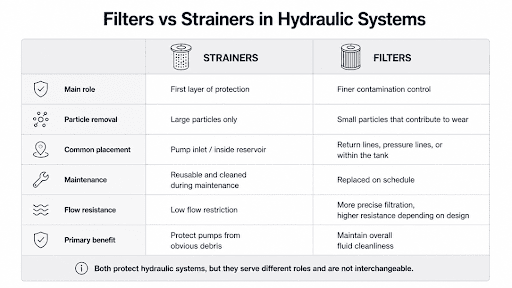
Strainers act as the first layer of protection against large debris in hydraulic circuits. They are usually made from perforated metal or coarse mesh and placed where fluid enters the system.
Hydraulic reservoir suction strainers sit inside the tank at the pump inlet. Their role is simple: stop larger particles before they reach the pump, reducing the risk of damage from debris such as metal fragments or rubber pieces.
Strainers are reusable and can be cleaned during maintenance. However, they do not capture fine particles, so they are not intended for final fluid conditioning. They are best used where flow restriction must stay low while blocking obvious contamination.
Filters and Their Role
Filters handle finer contamination control. Unlike strainers, they use layered media designed to capture small particles that contribute to long-term wear in hydraulic components.
Hydraulic tank filters help maintain fluid cleanliness inside the reservoir by controlling contamination that returns during operation. This reduces buildup over time and supports longer service life for pumps, valves, and actuators.
They can be installed in return lines, pressure lines, or within the tank. Filters are typically replaced on schedule rather than cleaned, depending on system design and operating conditions. Their focus is maintaining fluid quality rather than blocking large debris.
Suction Filters vs Hydraulic Reservoir Suction Strainers
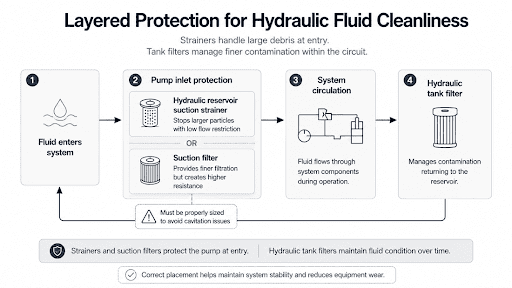
Suction-side protection often comes down to two options. Hydraulic reservoir suction strainers are common in many systems because they allow free flow while stopping large contaminants.
Suction filters provide finer filtration at the pump inlet, but they create higher flow resistance. If not properly sized, this can lead to cavitation issues.
The choice depends on system requirements. Harsh environments often rely on strainers, while cleaner or more sensitive systems may use suction filters for better contamination control.
Hydraulic Tank Filters in System Protection
Hydraulic tank filters help maintain fluid condition over time by managing contamination returning to the reservoir. Without them, particles keep circulating and increase wear on system components.
In many systems, they work alongside suction strainers or suction filters to provide layered protection. Strainers handle large debris at entry, while tank filters manage finer contamination within the circuit.
Regular replacement helps maintain stable operation and reduces downtime linked to contamination issues.
Key Differences That Matter
- Strainers handle large particles only and mainly protect pumps at the intake stage
- Filters remove fine contamination and support overall fluid cleanliness
- Strainers are reusable and create low flow resistance
- Filters are replaceable and provide more precise filtration
- Both are used in hydraulic systems, but they serve different roles and are not interchangeable
- Correct placement helps maintain system stability and reduces equipment wear
Practical Selection Guidance
For pump inlet protection, hydraulic reservoir suction strainers are commonly used when flow restriction must stay minimal. If the system requires tighter contamination control, suction filters may be used instead, provided the pump can handle the added resistance.
For overall system cleanliness, hydraulic tank filters remain essential. They support consistent fluid conditions and reduce the burden on downstream components. Selecting the right combination depends on operating conditions, contamination levels, and equipment sensitivity.
Keep Your Hydraulics Running Clean—Before Downtime Gets Expensive
Contamination doesn’t wait, and neither should your maintenance plan. Whether you need hydraulic tank filters, hydraulic reservoir suction strainers, or dependable suction filters, the right component makes a real difference in system performance and equipment life.
DOMS Inc. supports industrial operations with filtration and hydraulic components built for demanding environments. If your system depends on clean fluid flow, it’s worth getting the right fit from the start.
Check available products or contact us and request support from our team.
Differences Between Filter Types
Comments Off on Differences Between Filter TypesMaintaining the integrity of a hydraulic system requires a deep understanding of the specific components that keep it running. Filtration is not a one size fits all solution, as each stage of a fluid power system presents unique challenges. Choosing the wrong media or placement can lead to pump cavitation, component wear, or total system failure.
At DOMS Incorporated, we provide high performance solutions designed to protect your machinery from the most demanding environments. Our team specializes in engineering precision components that ensure maximum uptime and operational efficiency for your fleet, from suction filters to can filters, air filters and more. You can trust DOMS Incorporated to deliver the reliability your heavy duty equipment deserves. Contact us today to learn more!
Basic Qualities of Common Filter Types
Suction Filters
These components are specifically designed to remove fine contaminants from the suction line of a hydraulic system. They typically capture solid particulates and pollutants that are smaller than 50 microns in size. By cleaning the fluid before it reaches the pump, suction filters provide a critical line of defense. Our designs feature a rounded root and crest pleat that maximizes the available surface area for better flow.
Can Filters
These units are often utilized for their versatility and ease of installation within various fluid systems. Many operators prefer can filters when they need a self contained unit that protects against external debris. They are common in both industrial and mobile applications where space and accessibility are primary concerns. Using high quality can filters ensures that your system remains sealed and free from environmental pollutants.
Hydraulic Filters
Effective hydraulic filters are essential for maintaining the cleanliness of the fluid that powers your actuators and motors. They are strategically placed throughout the system to catch wear debris generated by moving parts. Without reliable hydraulic filters, these small metal shavings can cause significant internal damage over time. We offer these in various configurations to handle different pressure levels and flow requirements across your machinery.
Air Filters
Air filters are used to boost the quality of air in systems like motors and air compressors. They are designed with high air permeability to prevent dangerous pressure differentials and contamination buildup. You can choose from synthetic or stainless steel construction depending on the harshness of your environment. These filters ensure that the air entering your equipment is clean and free of abrasive particles.
Spin-On Filters
For systems that require quick and easy maintenance, spin-on filters are an excellent and economical choice. They are designed for direct in-line mounting, which simplifies the replacement process and reduces housekeeping requirements. These are ideal for low pressure systems like cooling circuits and fuel transfer lines. Their design ensures that you can perform field maintenance without specialized tools or extensive downtime.
Reservoir Breather Filters
As fluid levels change within a tank, reservoir breather filters allow the system to breathe while blocking moisture and dust. They are mounted on the tank or reservoir to ensure that only clean air enters the headspace. This prevents the ingestion of airborne contaminants that could otherwise degrade the hydraulic fluid. These breathers are a simple yet vital component for extending the life of your entire hydraulic circuit.
How to Choose the Right Filter
Selecting the proper filtration starts with understanding the operating pressure and flow rate of your specific application. You must also consider the type of fluid being used and the environment where the machine operates. A filter that works well in a controlled factory setting may fail in a dusty mining operation. Always evaluate the micron rating to ensure the media can capture the specific types of debris common to your industry.
Determining the bypass valve settings is another critical step in your selection process. If the pressure drop becomes too high, the fluid might bypass the media entirely to prevent housing rupture. This means your suction filters or return line units must be sized correctly to handle cold starts. Proper sizing ensures that your hydraulic filters protect the system even during fluctuating temperature conditions.
DOMS Incorporated is Here to Help
With over 60 years of experience, our team knows how to solve complex filtration challenges for global OEMs. Our internal testing and quality control processes guarantee that every part meets rigorous industry standards. We work closely with your engineering department to refine designs for better flow and durability. This collaborative approach allows us to create can filters that perfectly fit your unique housing requirements. Our goal is to provide a seamless supply chain experience for all your filtration needs.
We offer custom design services to ensure your parts meet exact specifications, even for discontinued or rare equipment. Whether you need standard suction filters or specialized hydraulic filters, we have the expertise to support your goals. Please contact us today to discuss your project requirements with our engineering experts.
Applications for Industrial Diffusers
Comments Off on Applications for Industrial DiffusersIndustrial diffusers are used to control and direct the movement of fluid or air within industrial systems. In hydraulic applications, an industrial diffuser helps manage return-line flow as fluid re-enters a reservoir, reducing turbulence, foaming, and unnecessary agitation inside the tank. In airflow applications, an industrial air diffuser helps distribute air through a facility for more consistent ventilation and airflow coverage.
These components serve different systems, but the purpose is similar: better flow control, more stable performance, and fewer avoidable issues inside the equipment or facility. For OEMs, plant operators, and maintenance teams, the right diffuser can support cleaner operation, reduce stress on system components, and help maintain consistent performance over time.
Industrial Diffusers in Hydraulic Reservoir Systems
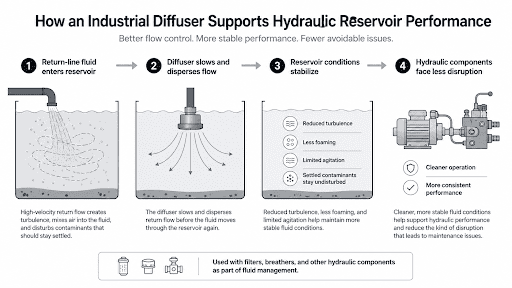
One of the most important applications for an industrial diffuser is inside hydraulic reservoir systems. When hydraulic fluid returns to the tank at a high velocity, it can create turbulence, mix air into the fluid, and disturb contaminants that should stay settled at the bottom of the reservoir. Those issues can affect fluid quality and create added wear on pumps, valves, and other hydraulic components.
A diffuser helps slow and disperse return flow before the fluid moves through the reservoir again. This gives the system a better chance to reduce foaming, limit agitation, and maintain more stable fluid conditions. In practical terms, that can help support better hydraulic performance and reduce the kind of fluid disruption that leads to maintenance problems over time.
For many industrial systems, the diffuser works alongside filters, breathers, and other hydraulic components as part of a broader fluid management strategy. It is a small component with a direct effect on reservoir performance.
Common Applications Across Industrial Equipment and Operations
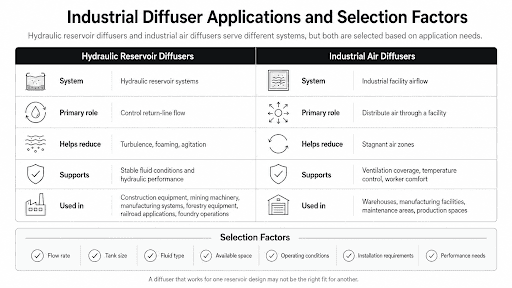
Industrial diffusers are used across a wide range of heavy-duty applications where hydraulic reliability is a day-to-day requirement. Construction equipment, mining machinery, manufacturing systems, forestry equipment, railroad applications, and foundry operations all rely on hydraulic systems that need to perform under pressure and in demanding environments.
In these applications, an industrial diffuser supports the system by helping control return-line flow inside the reservoir and reducing fluid disturbance that can affect system efficiency. For equipment manufacturers and industrial operators, that matters because unstable fluid conditions can lead to unnecessary wear, contamination issues, and downtime.
This is where product selection becomes important. Diffuser performance depends on factors such as:
- Flow rate
- Tank size
- Fluid type
- Available space
- Operating conditions
A diffuser that works for one reservoir design may not be the right fit for another. DOMS Incorporated manufactures diffuser solutions for industrial hydraulic systems and works with customers that need dependable components built around real application requirements. That may include standard products, replacement parts, or custom diffuser designs for specific equipment and reservoir setups.
Industrial Air Diffusers in Facility Airflow Applications
An industrial air diffuser serves a different function, but it is still focused on flow control. Instead of managing hydraulic return fluid, it helps distribute air within industrial buildings such as warehouses, manufacturing facilities, maintenance areas, and production spaces. These diffusers are used to direct airflow more evenly across a space, which can improve ventilation coverage and reduce stagnant air zones.
In some facilities, proper air distribution also supports temperature control, worker comfort, and better airflow in enclosed or high-activity areas. While hydraulic diffusers and air diffusers are used in different systems, both are selected based on performance needs, installation requirements, and the conditions of the operating environment.
Keep Flow Problems From Turning Into Bigger Equipment Problems
If your hydraulic system needs better return-line flow control, DOMS Incorporated can help you find the right industrial diffuser for the job. From standard options to custom-built solutions, our team works with OEMs and industrial customers who need dependable diffuser performance in demanding applications. Contact DOMS today to discuss your system requirements and get a diffuser solution built for the way your equipment actually operates.